
Thematic ETFs
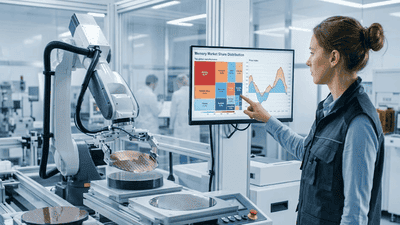
Cyclical Pricing Power Shifts Reflected by the HHI Industry Concentration Index for Memory
Pricing power in the memory sector does not move in a straight line. It ebbs and flows with cycles of demand, supply, consolidation, and technological transition. At the same time, the industry’s structure — who holds how much market share — is not static either. One of the most useful ways to capture this structure is the Herfindahl-Hirschman Index (HHI), a simple but powerful concentration metric that can reveal how much leverage the leading players have at any given moment.

Active Correction Strategies for the Systematically Underweighted Memory Weight in AI Compute Indices
Most AI compute indicators and ETFs are built around the obvious heroes: GPUs, accelerators, and custom AI chips. Memory—the bandwidth and capacity that feed those chips—often shows up as a supporting cast with smaller index weights. That systematic underweighting of memory in AI compute indicators is understandable from a market-cap and narrative perspective, but it is increasingly at odds with how AI infrastructure actually works. If memory is a bottleneck, underweighting it is not just a technical quirk; it is a structural allocation error.
Overweight/Underweight Execution via Memory Thematic ETFs in Sector Rotation
Sector rotation in the age of AI is no longer just about “tech vs cyclicals” or “growth vs value.” It is increasingly about which layer of the AI stack you choose to emphasize at any given moment: compute, memory, storage, networking, or power. Among these, memory has quietly become one of the most powerful levers, because it sits at the bottleneck where AI performance and cost converge. Using memory-focused, or “memory semantic,” ETFs to execute overweight and underweight decisions inside broader sector rotation frameworks opens up a new, more nuanced way of moving capital between themes.

Inferring Institutional Views on Memory via Quarterly Holdings Changes in AI Infrastructure ETFs
What do big institutions really think about the future of memory, storage, and compute in artificial intelligence? They rarely tell you directly. Instead, they speak through their portfolios, their rebalancing moves, their quiet shifts in exposure every quarter. One of the most revealing places to listen is in the holdings of AI infrastructure exchange-traded funds (ETFs), especially the way those holdings evolve over time.

Liquidity Impact Cost Assessment for Thematic ETFs – The Case of Small-Cap Memory Constituents
AI storage and computing power have turned memory from a supporting character into a main protagonist. New thematic ETFs built around DRAM, HBM, NAND and enterprise storage are launching into a market where demand is surging and price cycles are volatile. But underneath the narrative lies a practical question that matters a lot for investors and product designers: what does it actually cost, in liquidity terms, to include small cap memory names in these vehicles?

Record New Launches of Memory/AI Thematic ETFs in 2026 – Capital Siphoning Effects
The 2026 boom in memory and AI-themed ETFs has done more than add a few tickers to the market. It has rewired how capital finds its way into AI storage and computing power. Funds like pure‑play memory ETFs and AI hardware baskets raised billions within weeks, breaking launch records that were previously reserved for broad index or Bitcoin products. That speed is not just a measure of investor enthusiasm; it is evidence of a capital siphoning effect, where money that might have gone into individual memory names, broad semis, or general AI equity now flows through a concentrated thematic wrapper instead.

2026 Investor Structure Shifts in Memory Thematic ETFs – Retail Out, Institutions In
In early 2026, AI memory suddenly became the center of the hardware universe. High-bandwidth memory, DRAM, NAND, and storage systems turned into the choke point for training and running large models, and the first wave of memory-focused ETFs arrived just in time to catch that realization. The result was explosive: assets piled in, performance numbers looked surreal, and social media declared “the memory trade” as the new frontier. But as the months passed, a quieter story unfolded underneath the price charts—who actually owns these memory ETFs is changing.
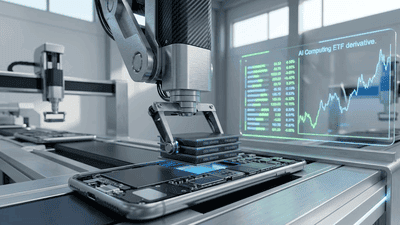
A High-Frequency Leading Indicator Model Linking Memory Indices and PC/Smartphone Shipments
In technology markets, most of the attention goes to the shiny devices we can see and touch: PCs, laptops, smartphones, tablets. Yet the real heartbeat of those markets often lies in something far more invisible — memory. DRAM, NAND, and related storage components set the pace for production, shape margins, and quietly telegraph where demand is headed before shipment reports or earnings calls ever arrive. If you want to build an ETF or index derivative around AI storage and computing power, learning to read those memory signals is not just helpful; it is foundational.
Investment Implications of the World’s First HBM Thematic ETF Listing in Korea
By 2027, the semiconductor ETF industry will be less about “chips” in the abstract and more about the specific machinery behind AI: storage and computing power. The capital markets are already shifting in that direction, carving out ETFs and index derivatives that track not only general semiconductors, but the precise hardware bottlenecks for AI workloads—HBM memory stacks, accelerator compute, advanced interconnects, and cooling infrastructure. The result will be a landscape where product innovation and investor behavior evolve together, reshaping what it means to invest in “semis.”
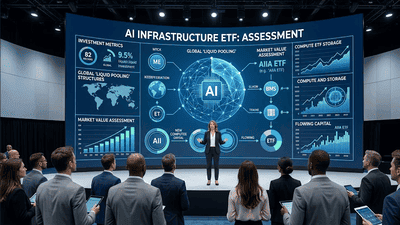
Investment Value Assessment of the World’s First Liquid-Cooling AI Infrastructure ETF
AI is no longer just about algorithms and GPUs. It is about racks, megawatts, memory channels, cooling loops, fiber routes and power grids. As investors have started to appreciate that, AI infrastructure ETFs have begun to appear—funds that own the physical and technical backbone of AI rather than just the software and chips running on top of it. Now imagine a step further: a “liquid pooling” AI infrastructure ETF, designed not just to hold infrastructure stocks, but to behave like a pooled participation vehicle for the entire AI infrastructure stack.
Popular

Narrowing Spread Between NAND Spot and Contract Prices in 2026 – A Signal
By 2026, one of the most watched metrics in the NAND flash market has started to shift in a subtle but meaningful way: the spread between spot prices and long‑term contract prices is narrowing. For casual observers, this may look like just another incremental change in a notoriously volatile industry. For memory makers, module houses, device OEMs, and data center buyers, however, a tightening gap between spot and contract prices is a signal—a reflection of evolving supply–demand balance, risk perceptions, and strategic behavior on both sides of the market.

Price Divergence Trading Strategies Between NAND Flash and DRAM ETFs
NAND flash and DRAM sit at the core of AI storage and computing power. Both are memory, but they are not the same business. DRAM is main memory—fast, volatile, and central to high‑bandwidth workloads like AI training and inference. NAND is non‑volatile storage—slower than DRAM, but crucial to persistent data and large‑scale object storage. The cycles that drive their pricing and margins overlap, yet they often diverge. That divergence is where trading strategies between NAND and DRAM ETFs become interesting.

China’s HBM Localization Progress: The Catch-Up Pace of CXMT and XMC
China’s drive to localize advanced memory technologies has accelerated over the past several years. High-Bandwidth Memory (HBM) sits near the center of that strategy because it is integral to AI accelerators, high-performance computing (HPC) and other strategic compute platforms. Two domestic players—ChangXin Memory Technologies (CXMT) and XMC (Xianghui Memory, commonly referred to as XMC)—have become focal points in assessing how quickly China can close the gap with international incumbents on HBM die, stacking, and packaging.